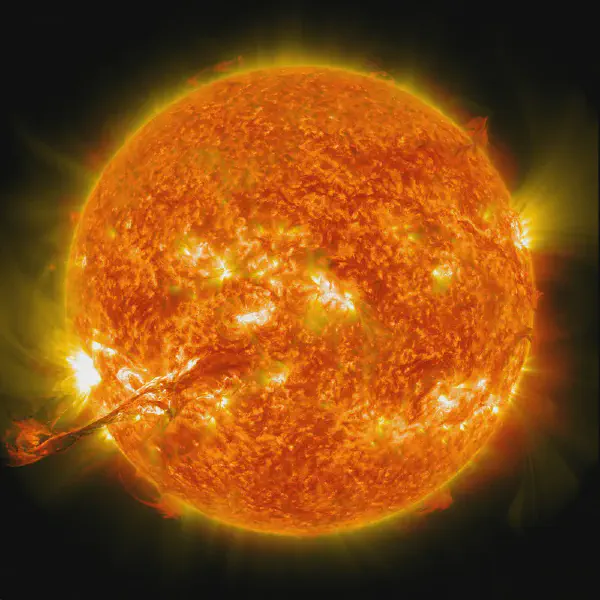
The Burning Sun Misconception
The misunderstood heat of the Sun: science vs fiction
4 min read
The Sun Doesn’t “Burn” as We Think #
The misunderstood heat of the Sun: science vs fiction.
The idea that “the Sun burns hot” is a common assumption, but it’s technically misleading or, at least, incomplete. The Sun itself doesn’t “burn” in the traditional sense like fire or flames. Instead, it emits radiation — a wide spectrum of electromagnetic waves — which travel through space until they reach Earth.
The feeling of heat that we experience from the Sun isn’t because its heat travels through space directly and warms us, but rather due to how solar radiation interacts with Earth’s atmosphere and, ultimately, our bodies.
Radiation Travels Through Space — Not Heat #
In space, there’s no air or matter for the Sun’s energy to heat up. Space is almost a perfect vacuum, so radiation travels through it without “warming” anything directly. It’s only when these electromagnetic waves — particularly those in the higher energy part of the spectrum, like ultraviolet and visible light — reach Earth’s atmosphere that a transformation begins.
The upper layers of the atmosphere absorb and scatter some of this high-energy radiation. As these light waves interact with atmospheric molecules, part of their energy is transferred, lowering the frequency of the waves. This process shifts some of the radiation down the spectrum, converting it into infrared — the actual heat we feel on our skin.
This is why we only feel the Sun’s warmth once we are inside the atmospheric “bubble” of Earth. Without an atmosphere, there would still be solar radiation, but not the same sensation of warmth. Astronauts in space, for example, don’t feel heat in the same way — unless the radiation hits a surface and is absorbed, converting into heat energy.
Temperature of the Sun Is Measured by Light, Not Contact #
Another important point that adds to this misunderstanding is how we actually determine the Sun’s temperature. Contrary to what many may think, we don’t measure the Sun’s heat through direct contact or physical probes — that would be impossible due to the extreme conditions.
Instead, scientists determine the Sun’s surface temperature (the photosphere) by analyzing the light it emits — or more precisely, its electromagnetic spectrum. This is done through spectroscopy, which breaks down sunlight into its component wavelengths. By studying the patterns of emission and absorption, scientists can calculate the Sun’s surface temperature.
The Sun emits most of its light in the visible spectrum, peaking in the yellow/green area, which corresponds to a blackbody temperature of around 5,500 to 6,000°C (about 10,000°F). This is a translation of the Sun’s light color into a direct temperature value using laws of physics, such as Planck’s Law and Wien’s Displacement Law — not from physical or thermal sensation.
The Role of Earth’s Atmosphere in “Feeling” Heat #
To be clear, the sensation of heat that we feel on Earth isn’t because we are directly feeling the Sun’s temperature. Instead, the Sun’s radiation hits our atmosphere, interacts with gas molecules, and is partially converted to infrared energy — the real cause of the warmth we feel.
So, the Sun’s temperature is a calculated physical value, and the heat we feel is a local atmospheric phenomenon. These are two different things that often get confused as one.
Pop Culture and Cinema Fuel the Misconception #
The reason most people mistakenly believe the Sun “burns” like a furnace or giant fireball is largely influenced by how the Sun is portrayed in cinema, especially in space-themed science fiction movies. These films often show the Sun as a violently burning, glowing mass, capable of instantly destroying anything that gets too close — like a ship melting just by flying nearby.
These visual effects serve the purpose of drama and storytelling, but they’re scientifically inaccurate. What many people overlook is the meaning of the term “sci-fi” — science fiction. These are imagined worlds built with fictional or stretched scientific laws to support the plot, not real science.
Unfortunately, these strong visuals become deeply embedded in our imagination, shaping public understanding and reinforcing inaccurate assumptions — especially when they are not counterbalanced by scientific explanation.
Understanding the Real Sun #
In reality, space doesn’t behave like in the movies. The Sun doesn’t “burn” in the way we’re used to seeing on screen, and space isn’t filled with heat. The warmth we feel is the result of a complex interaction between radiation and Earth’s atmosphere — not a direct blast of heat from the Sun itself.
The Sun’s temperature is calculated through the analysis of light, and heat as we know it only emerges once that radiation is absorbed and transformed within Earth’s environment.
Understanding the difference between cinematic fiction and scientific fact helps clear up a widespread misconception. It also highlights how fascinating and intricate the real workings of the universe are — much more interesting than even Hollywood can imagine.
Disclaimer: This article and its contents are protected by copyright. Reproduction, distribution, or use of any part of this material without prior written permission from the author is strictly prohibited.
Copyright © Hugo V Monteiro